
Sector Watch: The Energy Security Pivot Accelerates
Authored by Boredom Baron via Substack,
Four sectors demand specific attention this week, and the supply chain dynamics within each are more nuanced than the headlines suggest.
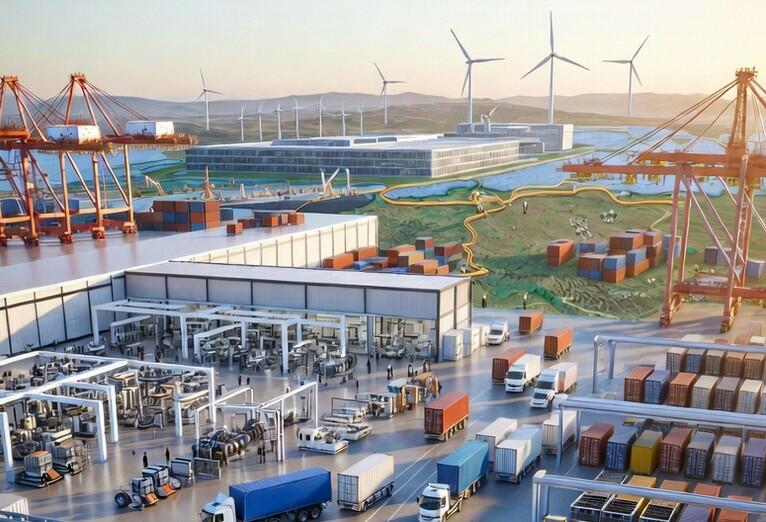
Logistics and Transportation face existential cost pressure, but the picture is bifurcating exactly as I suggested it would. The Denmark story, with the government begging citizens to “please, please, please” avoid driving, tells you how directly the energy shock is hitting consumer behavior and by extension transportation demand. European road freight is already under structural pressure: contract freight rates climbed 2.6 points quarter-over-quarter in Q4 2025 as major shippers locked in rates ahead of anticipated capacity tightening. The spread between contract and spot rates is a real-time barometer of corporate panic: when shippers are willing to pay a heavy premium for guaranteed truck availability over volatile spot pricing, it suggests boardrooms expect logistics disruptions to persist. Add the Hormuz closure on top of a pre-existing 444,000 driver shortage across Europe, and the pressure on transport-dependent small-caps is severe. But the restructuring of global trade routes around the Hormuz blockade is also creating winners. European logistics hubs positioned as alternative gateways for Asian goods, particularly those with rail connections to Central Asian corridors, could see structural increases in volume. The Global Baku Forum this week highlighted the “Middle Corridor” linking Asia and Europe through the Caucasus as a strategic transport opportunity that is gaining momentum.
Defense and Dual-Use Infrastructure continues to be the most structurally advantaged sector in our universe. European governments are demonstrating a strict, legislatively mandated preference for domestic procurement to guarantee sovereignty and the security of supply, which means the multi-decade rearmament cycle (anchored by Germany’s €500 billion infrastructure plan and the Readiness 2030 initiative) flows disproportionately to European small– and mid-cap precision component manufacturers, not just the headline-grabbing prime contractors. Modern defense platforms require vast networks of deeply specialized suppliers producing complex avionics, precision optical sensors, hardened materials, and secure communications equipment. The qualification processes in aerospace (3-7 years to certify a component, then specified for the aircraft’s 30+ year lifecycle with recurring maintenance revenue) create the most durable competitive moats in European small-cap investing. Companies strategically positioned at the intersection of civilian infrastructure and defense mobility are essentially insulated from standard cyclical downturns by the non-discretionary nature of sovereign budgets.
Warehouse Automation and Industrial Robotics is the sector that directly benefits from the nearshoring paradox I described in Contrarian #4. Every factory relocated from Asia to Central Europe needs automated systems to offset higher labor costs. The European warehouse automation market is projected to compound at double-digit rates through 2034, driven by labor shortages and vacancy rates exceeding 12% in European logistics, which sent robot installations up 28% in Central and Eastern Europe. The ecosystem extends beyond traditional robotic arms to encompass Autonomous Mobile Robots (AMRs), high-resolution LiDAR sensors, force-torque sensors, and AI-driven Warehouse Management Systems. Companies like Kardex Holding, Interroll Holding, and AutoStore aren’t selling into a cyclical demand pulse. They’re selling shovels during a structural gold rush, as European supply chain leaders confirm that cost reduction has definitively superseded innovation as the paramount objective for technology integration. Approximately 25% of EU firms have now invested in proprietary digital tracking systems to fortify supply chain visibility, and that percentage will only grow as Hormuz-related disruptions persist.
Energy Infrastructure and Alternatives are seeing renewed interest. Europe switched on its first microgrid-connected data center this week in Ireland, a niche story that nonetheless signals the direction of travel. Every week that Hormuz remains closed strengthens the investment case for distributed energy generation, waste-to-energy operations, and grid infrastructure companies. SoftBank’s $33 billion US power plant deal shows that institutional capital is making enormous bets on energy security. But there’s a contrarian wrinkle here too: the green transition requires exponential increases in critical raw materials, most notably rare earth elements, lithium, and cobalt, whose extraction and processing are dominated by China. The EU’s Critical Raw Materials Act aims to boost domestic recycling and extraction, but actual operational progress is dangerously slow relative to the pace of mandated decarbonization. Companies accelerating the energy transition could find themselves swapping a dependency on Middle Eastern hydrocarbons for a dependency on Chinese processed metals. That’s not energy security. That’s energy dependency with different geography.
Subscribe to Boredom Baron here…
Tyler Durden
Mon, 03/16/2026 – 07:20